Guidance for Implementation of the AASHTO Strategic Highway Safety Plan
Outline for a Model Implementation Process
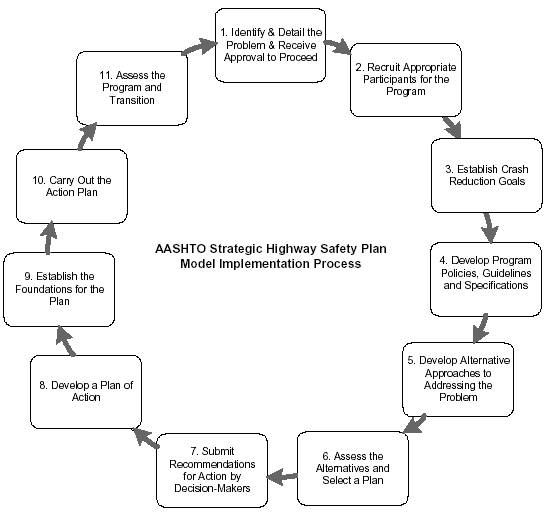
The diagram below provides a basic overview of an eleven-step process recommended for implementing a program of strategies for any given emphasis area of the AASHTO Strategic Highway Safety Plan.
This document provides an overview for the process, as well as a detailed outline that can be adapted by an agency to fit their needs and approach to any of the emphasis areas.
The process (See Exhibit 1, above) must be initiated at a strategic level (i.e., top management such as the CEO, DOT Secretary, or Chief Engineer, as appropriate) in the organization. Here, decisions are made to focus the agency's attention and resources on specific safety problems based upon the particular conditions and characteristics of the organization's roadway system. This is usually documented in the form of a "highway safety plan." Several states have examples" Washington State DOT Highway Safety Plan, Wisconsin DOT Safety Plan, and Iowa Safety Plan).
Once such a "high-level" decision has been made to proceed with a particular emphasis area, the first step is to characterize in detail, the problem that has been discovered in the high-level analysis (Step 1). This step is important in that there is often a need to confirm with management that, given the details of what has been learned in this step, it is still appropriate to proceed (or alternatively, refocus attention on other emphasis areas). Endorsement and management commitment are the necessary outcomes of Step 1. With such endorsement, it is then necessary to identify the stakeholders and define their role in the effort (Step 2). It is important at this step to identify a range of participants in the process who will be able to help formulate a comprehensive approach to the problem. The group will want to consider how it can draw upon potential behavioral, engineering, emergency medical system, and system-management actions. With the establishment of a working group it is then possible to finalize an understanding of the nature and limitations of what will be done, in the form of a set of program policies, guidelines and specifications (Steps 3 and 4). An important aspect of ths is establishing targets for crash reduction in the particular emphasis area (Step 3). Identifying stakeholders, defining their roles, and forming guidelines and policies are all elements of what is often referred to as chartering the team. In many cases, and in particular where only one or two agencies are to be involved and the issues are not complex, it may be possible to complete Steps 1, 2, and 3 concurrently.
Having received management endorsement and chartered a project team, the foundation for the work, it is now possible to proceed with project planning. The first step in this phase (Step 5 in the overall process) is to identify alternative strategies for addressing the safety problem(s) that have been identified, remaining faithful to the conditions established in Steps 2 and 3.
With the alternative strategies sufficiently defined, they must be evaluated against each other (Step 6), and as groups of compatible strategies (i.e., a total program). The results of the assessment will form the recommended plan, which will be submitted to the appropriate levels of management for review and input, resulting ultimately in a decision on whether and how to proceed (Step 7). Once the working group has been given approval to proceed, along with any further guidelines that may have come from management, the group can develop a detailed plan of action (Step 8). This is sometimes referred to as an "implementation" or "business" plan.
Plan implementation is covered in steps 9 and 10.There often are underlying activities that must take place prior to implementing the action plan to form a foundation for what is to be done (Step 9). This essentially involves creating the organizational, operational and physical infrastructure needed to succeed. The major step (Step 10) in this process involves actually doing what was planned. This step will in most cases require the greatest resource commitment of the agency. An important aspect of implementation involves maintaining appropriate documentation of costs, effectiveness, etc., to enable plan evaluation.
A critical step involves the evaluation and assessment of the program. Management will require information on costs, resources, effectiveness, and recommendations for continuation, revision, and transitioning from the development team to others within the agency for continuation. Note that management will be assessing each specific emphasis area program being undertaken. Step 11 involves those activities to provide this information to management.
To summarize, the implementation of a program of strategies for an emphasis area can be characterized as a ten-step process. The steps in the process fit closely to a four-phase approach commonly followed by many transportation agencies:
Endorsement and Chartering of the Team and Project (Steps 1 through 4)
Project Planning (Steps 5 through 8)
Plan Implementation (Steps 9 and 10)
Plan Assessment (Step 11)
Details on each step follow. The web-based version of this description is accompanied by a set of supplementary material to enhance and illustrate the points.
In 1981, the FHWA developed a detailed document on an engineering-oriented process similar to the one outlined herein. While it does not address non-engineering options in a significant manner, and it does not reflect the many organizational and institutional activities needed in an implementation process, it still can be a used to provide supplementary details. The electronic version of the document is available but it is somewhat out-of-date. http://www.fhwa.dot.gov/tfhrc/safety/pubs/81218/intro.htm FHWA has recently started a program to renew this and other related documents for safety analysis.