Safety is often not given adequate consideration in making design decisions because safety-related data are not of sufficient quality because:
appropriate information can not be readily produced
appropriate analytical tools are not available to designers
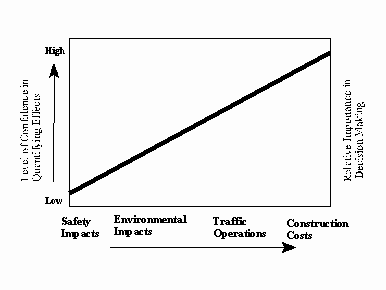
Yet, designers wish to address safety in their work. However, the problems they face in obtaining and using safety data result in these data not being given their proper weight in decision making. This is illustrated by Exhibit 1.
Designers tend to weigh those factors in which they have the greatest confidence. These include estimates of construction costs and quantified right-of-way impacts. Public opinions regarding alternative decisions also tend to carry weight in decision-making. The designer often considers information about crashes — their location, environmental factors, causes, etc., as incomplete, missing, or clearly erroneous. Typically, they have neither the time nor resources to correct the problems, and so must proceed with information that is of lesser quality than other factors being considered. As a result, designers tend to lack confidence in the ability to predict or quantify safety effects of alternatives. In this manner, safety inevitably becomes a lesser or secondary factor in decision-making. Specific issues are described in the sections below.
Safety data collection shortcomings.
Problems exist with respect to the police crash report, the type and quality of data maintained that describe the highway environment, and dynamic data such as traffic volume and speed. Data shortcomings can be attributed in part to lack of a focus, or priority, for safety, when the agencies responsible for data collection establish procedures and protocols.
The primary source of crash information is the police crash report (PCR). In many cases, such reports do not exist. Where they do, the information which the designer believes to be most important is missing, especially the location of the crash. Because the reporting police officer has primary responsibility to secure the scene, see to the treatment of the injured, and minimize resulting congestion, he or she will not likely take the time to properly locate the points of impact, or precisely record other roadway related elements.
With respect to the roadway, much data of critical importance to safety typically are not collected and maintained by highway agencies. For example, the character of the roadside is acknowledged to be among the most important factors affecting safety on two-lane rural highways, While most states maintain a video log of a portion of their system, few states maintain quantitative records of roadside features, or conditions, sufficient for use in decision making. Most agencies also fail to inventory geometric features such as horizontal alignment, vertical alignment, and intersections, all elements acknowledged by current thinking to be related to crash frequency and severity.
Similarly, although traffic data are maintained by most agencies, the data generally are not of sufficient quality to support safety decisions. Traffic volume data for intersection movements generally are not available. Adequate information about vehicle speeds often is lacking. The frequency with which traffic volume data are updated may be sufficient for, pavement management systems, for example, but not for characterizing use in safety analyses.
Safety data management issues.
The needs to improve aspects of data management include establishment of linkages between databases, making use of information not traditionally accessed by designers, and maintenance of history files.
Potentially-valuable data are maintained by various agencies for purposes other than those related to highway safety. These are often not accessible, and hence not utilized. Examples include maintenance records (guardrail replacement for example), pavement and bridge management systems, trauma records, and citizen complaints to police or highway agencies. Such data could offer insights to designers or safety analysts, but are typically not linked to safety data systems.
Most agencies do not maintain long-term records of the safety history of a highway. Most also do not maintain records of historical changes in geometric conditions, traffic volumes, or other related conditions for specific locations. Such data, maintained over a long time, and accessible to designers, would provide support to evaluations of the effectiveness of site-specific improvements, and thus would enhance decision making for future design decisions.
Furthermore, the analyst might not be able to generate information to make a connection between historical crash patterns and related conditions (for which data are available in the roadway inventory) because the location reference is often not precise enough, or is missing. Even if the linkage were possible, achieving it would be very time consuming, and records often do not contain adequate information about longitudinal geometrics. If the user were to evaluate a change in geometry at a site, a time-series analysis would probably be appropriate, requiring 10 years of data. However, a history of the roadway inventory might not be maintained, so the user cannot be sure if and when related changes were made to the highway. Finally, the designer may not have available traffic or other data that would be of value in considering design changes.
These are just a few of the difficulties faced when an attempt is made to use highway safety information to support highway design, and other highway safety activities. However, many agencies are, or already have, overcome many of these problems. There are various technological and non-technological steps to be taken to improve the quality of safety data.