The AASHTO Strategic Highway Safety Plan identified 22 goals to be pursued to achieve a significant reduction in highway crash fatalities. One of the hallmarks of the Plan is to approach safety problems in a comprehensive manner. The range of strategies available in the guides will ultimately cover various aspects of the road user, the highway, the vehicle, the environment, and the management system. The guides strongly encourage the user to develop a program to tackle a particular emphasis area from each of these perspectives, in a coordinated manner. To facilitate this, the electronic form of the material uses hypertext linkages to enable seamless integration of various approaches to a given problem. As more guides are developed for other emphasis areas, the extent and usefulness of this form of implementation will become ever more apparent.
AASHTO's overall goal is to move away from independent activities of engineers,
law enforcement, educators, judges, and other highway-safety specialists, and
to move to coordinated efforts. The implementation process outlined in the series
of guides promotes the formation of working groups and alliances that represent
all of the elements of the safety system. In so doing, they can draw upon their
combined expertise to reach the bottom-line goal of targeted reduction of crashes
and fatalities associated with a particular emphasis area.
Goal 15 in the Strategic Highway Safety Plan is Keeping Vehicles on the Roadway, and Goal 16 is Minimizing the Consequences of Leaving the Road. Subsequently, three emphasis areas evolved from these two goals, namely:
Run-off-road (ROR) crashes
Head-on crashes, and
Crashes with trees in hazardous locations.
The common solution to these emphasis areas is to keep the vehicle in the proper lane. While this will not eliminate crashes with other vehicles, pedestrians, bicyclists, and trains that may be in the path of the vehicle, it will eliminate many fatalities that result when a vehicle strays from the lane onto the roadside or into oncoming traffic. This section deals with ROR crashes.
ROR crashes involve vehicles that leave the travel lane and encroach onto the shoulder and beyond, and hit one or more of any number of natural or man-made objects, such as bridge walls, poles, embankments, guardrails, parked vehicles, and trees. (Because trees are the most abundant objects along the road, they are treated as a separate emphasis area.) ROR crashes usually involve only a single vehicle, although a ROR vehicle hitting a parked vehicle could be considered a multi-vehicle crash. A ROR crash, which typically consists of a vehicle encroaching onto the right shoulder and roadside, can also occur on the median side where the highway is separated, or on the opposite side when the vehicle crosses the opposing lanes of a non-divided highway.
Reducing the likelihood that a vehicle will leave the roadway through roadway design (e.g., flattening curves or installing shoulder rumble strips) prevents deaths and injuries resulting from ROR crashes. When an errant vehicle does encroach on the roadside, fatalities and injuries can be reduced if an agency can either minimize the likelihood of the vehicle crashing into an object (e.g., through object removal) or overturning (e.g., sideslope flattening), or can reduce the severity of the crash (e.g., by installing breakaway devices).
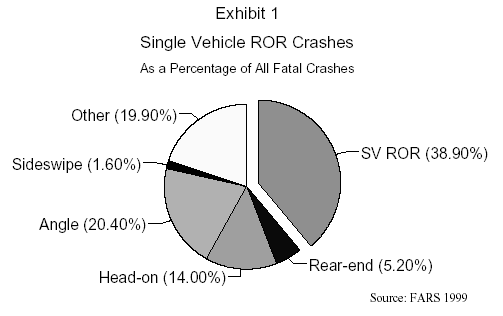
The 1999 statistics from the Fatality Analysis Reporting System (FARS) show that nearly 39 percent of the 37,043 fatal crashes involved single-vehicle ROR crashes for various road types. For two-lane undivided non-interchange, non-junction roadways exclusively, there were 8,901 (24 percent of total crashes) single vehicle run-off-the-road crashes.
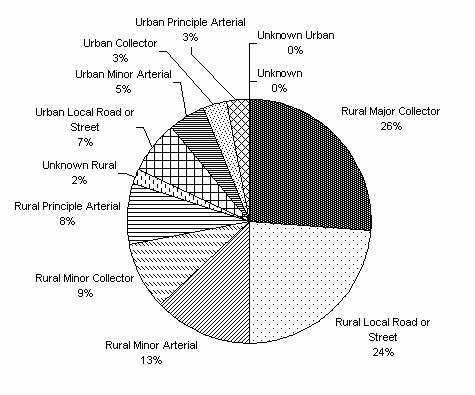
Exhibit 1 shows how single-vehicle ROR crashes on two-lane roads are distributed by roadway functional classification. There are more than twice as many ROR fatal crashes on rural roads than urban, which relates partly to the higher speeds on rural roads, and partly to their greater mileage.
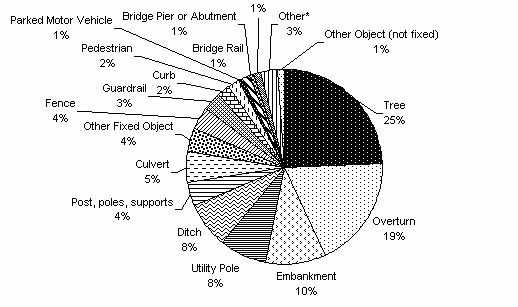
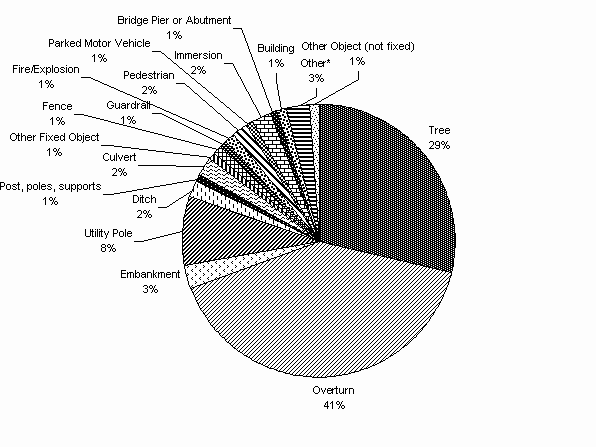
Exhibits 3 and 4 show the distribution of ROR crashes by First Harmful Event and Most Harmful Event for the same accident and roadway type, the latter being of higher severity (i.e., death) and the former being the first event or object hit, which may or may not have resulted in injury or fatality. Attention should be focused on the first harmful event for strategies that deal with eliminating or protecting drivers from various roadside objects; and to the most harmful event for strategies that minimize the severity of crashes when collisions with such objects do occur. As noted, the objects that are hit most often are trees.
Distribution of Single Vehicle Run-Off-Road Fatalities on Two-Lane Undivided Non-Interchange Non-Junction Roads by Highway Type (Source: 1999 FARS Data)
Distribution of Single Vehicle Run-Off-Road Fatalities for Two-Lane Undivided Non-Interchange/Junction Roads by First Harmful Event (Source: 1999 FARS Data)
* Other includes events which each represent less than 0.5% of the total
first harmful events: bridge parapet end, immersion, shrubbery, longitudinal
barriers (concrete or other), pedal cycle, other non-collision, fire hydrant,
snow bank, fell/jumped from vehicle, transport device used as equipment, animal,
unknown, pavement surface irregularity, fire/explosion, other type non-motorist,
vehicle occupant struck or run over by own, impact attenuator/crash cushion,
railroad train, gas inhalation.
Distribution of Single Vehicle Run-Off-Road Fatalities for Two-Lane Undivided Non-Interchange Non-Junction Roads by Most Harmful Event (Source: 1999 FARS Data)
* Other includes events which each represent less than 0.5% of the total first harmful events: bridge parapet end, immersion, shrubbery, longitudinal barriers (concrete or other), pedal cycle, other non-collision, fire hydrant, snow bank, fell/jumped from vehicle, transport device used as equipment, animal, unknown, pavement surface irregularity, fire/explosion, other type non-motorist, vehicle occupant struck or run over by own, impact attenuator/crash cushion, railroad train, gas inhalation.
To reduce the number of ROR fatality crashes, it would appear that the objectives should be to:
Keep vehicles from encroaching on the roadside
Minimize the likelihood of crashing or overturning if the vehicle travels off the shoulder
Reduce the severity of the crash.
The ideal objective of good design is to keep the vehicle in the travel lane. For vehicles that do cross the outside edge of pavement, a related objective is to enable the driver to safely recover on the shoulder before encountering the roadside. Motorists do not purposely move onto the shoulder unless they need to pull over to slow or stop their vehicle. However, errant vehicles will cross over onto the shoulder, with many proceeding onto the roadside, resulting in a ROR crash. The reasons for such errant events are varied and include avoiding a vehicle, object or animal in their travel lane, inattentive driving due to distraction, fatigue, sleep, and drugs; the effects of weather on pavement conditions; and traveling too fast through a curve or down a grade. There are also a number of roadway design factors that can increase the probability that a driver error will become a ROR crash (e.g., travel lanes that are too narrow, substandard curves, unforgiving shoulders and roadsides). Strategies can be applied to deal with the ROR crashes caused by these factors.
If the motorist travels onto the roadside, the probability of a crash occurring depends upon the roadside features, such as the presence and location of fixed objects, shoulder edge drop-off, sideslopes, ditches, and trees. If the roadside is fairly flat without objects and the soil can support the vehicle tires, then the probability of a serious crash is minimal (indeed, in many cases the motorist may fully recover and no ROR crash is reported). Conversely, where the roadside is populated with a continuous line of different types of objects and features, the sideslope is too steep for the vehicle to recover or if the soil produces "vehicle tripping," then the probability of a serious crash is high. Therefore, there are strategies directed at reducing the number and density of roadside features that would contribute to the likelihood of a ROR crash given a roadside encroachment.
The final objective, reducing the severity of the crash, can be met by changes in the design of the roadside features (e.g., making roadside hardware more forgiving, modifying sideslopes to prevent rollovers) and by changes in the vehicle (e.g., better restraint systems, improved side protection) or by increased occupant use of available restraints. While increased use of restraints would probably provide the greatest benefit, the emphasis in this discussion is on roadway-related improvements.
Exhibit 5 lists the objectives and several related strategies for reducing the consequences of ROR crashes. Details of these strategies are covered in the following narrative. It should be noted that this does not represent a listing of all possible strategies to reduce ROR crashes. For example, roadway design or rehabilitation strategies such as building wide lanes or adding lane width on entire systems or subsystems, or using positive guidance principals in new roadway design can clearly affect ROR crashes. However, these strategies are most likely employed in the design phase for new facilities or rehabilitiation of long sections of roadways, and are often relatively high-cost improvements. AASHTO has chosen to concentrate efforts in this Guide on lower cost strategies which can be implemented relatively quickly, which also implies strategies that can be applied to "spots" on the roadway (e.g., lane widening on hazardous curves). With few exceptions, it is these lower cost, quickly implementable strategies that are covered in the following pages.
|
Exhibit 5 |
|
|
Emphasis Area Objectives and Strategies |
|
|
Objectives |
Strategies |
|
15.1.1 Keep vehicles from encroaching on the roadside |
15.1.1.1 Shoulder rumble strips 15.1.1.2 Mid-lane rumble strips 15.1.1.3 Enhanced delineation of sharp curves 15.1.1.4 Improved highway geometry, especially for horizontal curves 15.1.1.5 Improved pavement markings 15.1.1.6 Elimination of shoulder drop-off (see "Shoulder Treatments") 15.1.1.7 Skid-resistant pavement surfaces |
|
15.1.2 Minimize the likelihood of crashing into an object or overturning if the vehicle travels beyond the edge of the shoulder |
15.1.2.1 Shoulder treatments |
|
15.1.3 Reduce the severity of the crash |
15.1.3.1 Improve design of roadside hardware (e.g., light poles, signs, bridge rails) (See "Improving Roadsides") 15.1.3.2 Improve design and application of barrier and attenuation systems (See "Improving roadsides") |
|
Note: Improved choice of roadside vegetation in beautification efforts (e.g. planting only small-trunk trees/shrubs will be covered in the emphasis area related to "Crashes with Trees in Hazardous Locations") |
|
The first objective addresses various means to communicate with the driver. However, other strategies for fulfilling this objective target highway design features that could contribute to a crash. The second objective employs strategies that focus on the highway, with more concentration devoted to non-freeway facilities, especially to higher speed rural roads. Higher-type facilities such as freeways typically have fairly wide shoulders and more forgiving, wider clear zones. Features within the clear zone are shielded from traffic by barriers and crash attenuation devices. On the other hand, there is an extensive system of mostly two-lane rural high-speed roadways that do not have these features. The crash data presented earlier give evidence that this system is particularly vulnerable to ROR crashes and should be targeted for appropriate measures. Vehicle design, restraint features and usage, and design of roadside features are all valid targets for the third objective, reducing the severity of ROR crashes.