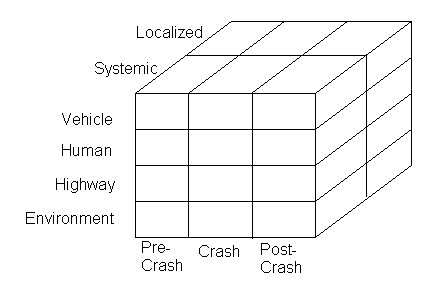
Exhibit 1 - A General Crash Analysis Framework
When analyzing safety of a road, it is necessary to recognize that one is dealing with a complex system. This means that a crash history for a system, or at a location, can be the result of a number of interacting factors. Exhibit 1 provides a schematic framework for this. There are generally four major factors studied:
Vehicle
Human
Highway
Environment
Exhibit 1 - A General Crash Analysis Framework
The AASHTO Strategic Highway Safety Plan focuses upon these major areas, and the organizational systems that manage them.
In general, the human aspect deals with the driver. However, it is important to remember that pedestrians and bicyclists are also critical and vulnerable parts of the total picture.
The environment generally includes all the elements that form the context in which the highway is operating. As such, it includes not only the physical environment (e.g., weather), but also the social environment (e.g., traffic laws and their enforcement, public attitudes on drunk driving), and support systems (e.g., emergency medical services).
When identifying safety problems, it is important to deal with an issue as a systems problem. This can help avoid misreading symptoms as causes of crashes. It also allows the safety manager to consider a wider range of options on how to treat identified problems.
When studying crashes, it is important to remember that they are the result of a sequence of events, some of which took place well before the actual harmful event(s), and others of which take place well after. Exhibit 1 includes this perspective, using the classical segmentation of a crash into its pre-crash, crash, and post-crash phases. Pre-crash events can include trip planning, drinking of alcoholic beverages at a party, getting inadequate sleep before a long trip, etc. They can also include actions taken by the driver, or changes occurring on the vehicle, just moments before the harmful event(s). The crash itself involves a whole set of dynamics which are often not recorded. However, police reports generally provide a conclusion regarding the first- and most-harmful events. The first harmful event is often a useful clue to a precipitating factor that may lead to ideas on how to improve the safety of the road. The most harmful event provides information that, in addition to a better perspective on the crash, may help focus in on what can be done to reduce the severity of crashes in the future. Post crash events can include things that happen immediately after the crash (e.g., rollover after collision with a fixed object), and it can include events occurring later (e.g., on-scene emergency medical treatment and trauma center treatment). Pre-crash events are often used to help focus upon crash prevention, whereas crash and post-crash events can best help identify means for severity reduction.
It is important to maintain the perspective that a crash is a sequence of events. This helps for a few reasons, whether one is performing analyses of data for an entire jurisdiction, or a single location. It helps:
The analyst to identify more than one event at which intervention may be made to avoid future crashes, so that the best combination of strategies can be identified.
To recognize that a crash does not occur at a point. In general, location data provided in crash reports are often inaccurate. However, even when reported accurately, only one point is recorded for the location of the crash. While the first, or most –harmful, event may occur at a point, the sequence of events immediately before and after those may be occurring along a few hundred feet of the road, and roadside. If understanding this leads the analyst to consider conditions along a greater length of roadway, then it might show the way to better conclusions on an effective intervention for the future.
The analyst to combine considerations from human, vehicle, highway and environmental factors when formulating an approach to an identified problem.
Finally, Exhibit 1 suggests that the highway-safety analyst should be considering factors that are present throughout the system in the jurisdiction, in addition to those that are local to a point, segment, corridor or small area. In some cases, systemic problems ( e.g., a design standard that is outdated) may be a significant underlying factor in crash experience at a particular location. Where systemic problems exist, they may require actions across the entire jurisdiction (e.g., modify all highways in the jurisdiction, or impose new licensing actions against unlicensed drivers, or install shoulder rumble strips). There is also the type of problem that may require a consistent action only on specific locations, but they are spread throughout the system. Even though this is considered a systemic problem, the locations may represent a relatively small portion of the total highway system along which a large portion of the identified problem occurs. An example would be where 60 percent of the crashes with roadside trees occur along only ten percent of the system mileage.
There are varied approaches to identifying highway safety problems. However, most require: